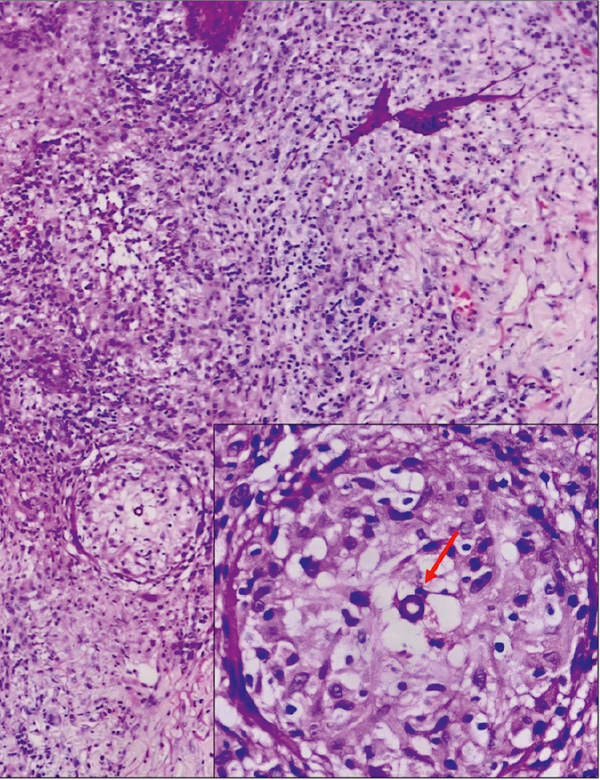
Do you recognize the diagnostic clue?
DOI:
https://doi.org/10.29176/2590843X.1836Keywords:
Chromoblastomycosis, dermatomycosis, Dematiaceous fungi, Subcutaneous mycosesAbstract
Chromoblastomycosis is a subcutaneous mycosis caused by traumatic inoculation of dematiaceous fungi. F. pedrosoi is the most distributed species in the tropical regions of Latin America, while Cladophialophora carrionii is more frequent in dry geographical areas of India and Thailand. 90% of cases are described in men between the ages of 20 and 60, especially farmers and miners. The most frequently affected anatomical areas are those prone to physical trauma, such as the hands, feet, knees, and elbows. The verrucous variant is the most common form of presentation and is characterized by exophytic verrucous plaques with black dots on its surface; however, other less frequent variants have been reported. In the present case, we report a patient with an annular and cicatricial form of chromoblastomycosis with the purpose of highlighting the importance of infectious diseases in the differential diagnosis of annular lesions.
Author Biographies
Camilo Ruiz, University of Antioquia
Médico; residente de Dermatología, Universidad de Antioquia, Medellín, Colombia.
Juan David Ruiz Restrepo, University of Antioquia
Dermatopatólogo; Docente de Dermatopatología, Sección de Dermatología, Facultad de Medicina, Universidad de Antioquia, Medellín, Colombia.
Luis Eduardo Muñoz Rayo, University of Antioquia
Médico; residente de Patología, Facultad de Medicina, Universidad de Antioquia, Medellín, Colombia.
Zully Milena González López, University of Antioquia
Médica dermatóloga. Docente, Sección de Dermatología, Facultad de Medicina, Universidad de Antioquia, Medellín, Colombia.
References
Liu WT, Sun PL, Bramono K, Ezmerli M, Yang CC, Chen W. Annular infectious dermatoses. Clinics in Dermatology. septiembre de 2022;40(5):427-40.
Arenas CM, Sánchez Tenorio L, Ballén Suárez J, Rodríguez Toro G. Síndrome verrugoso tropical. Piel. diciembre de 2016;31(10):699-705.
Pinos-León V, Ortiz-Prado E, Salazar M, Torres M. Cromoblastomicosis anular ulcerada. Piel. octubre de 2014;29(8):484-6.
Brito ACD, Bittencourt MDJS. Chromoblastomycosis: an etiological, epidemiological, clinical, diagnostic, and treatment update. An Bras Dermatol. agosto de 2018;93(4):495-506.
Falgout L, Hilton D. Clinical presentation and management of chromoblastomycosis: A case report and review. Medical Mycology Case Reports. septiembre de 2023;41:8-10.
Botello-Mojica HM, den-Medina LV en, Ayerbe FJ, Marulanda-Galvis MA. Cromomicosis, una enfermedad tropical olvidada: revisión de tema a propósito de un caso clínico. Revista de la Asociación Colombiana de Dermatología y Cirugía Dermatológica. 16 de abril de 2021;29(1):45-55.
Queiroz-Telles F, De Hoog S, Santos DWCL, Salgado CG, Vicente VA, Bonifaz A, et al. Chromoblastomycosis. Clin Microbiol Rev. enero de 2017;30(1):233-76.
Tirado-Sánchez A, Franco-Paredes C, Bonifaz A. Subcutaneous Mycoses in Travelers. Curr Trop Med Rep. diciembre de 2020;7(4):141-52.
Rosen T, Gyorkey F, Joseph LM, Batres E. Ultrastructural features of chromoblastomycosis. Int J Dermatol. octubre de 1980;19(8):461-8.
Rojas OC, González GM, Moreno-Treviño M, Salas-Alanis J. Chromoblastomycosis by Cladophialophora carrionii associated with squamous cell carcinoma and review of published reports. Mycopathologia. febrero de 2015;179(1-2):153-7.
Azevedo CMPS, Marques SG, Santos DWCL, Silva RR, Silva NF, Santos DA, et al. Squamous cell carcinoma derived from chronic chromoblastomycosis in Brazil. Clin Infect Dis. 15 de mayo de 2015;60(10):1500-4.
Universidad CES, Gaviria-Giraldo CM, Cardona-Castro N, Universidad CES. Esporotricosis y cromoblastomicosis: revisión de la literatura. CES Med. 2017;31(1):77-91.
How to Cite
Downloads
Downloads
Published
How to Cite
Issue
Section
License
Copyright (c) 2025 Camilo Ruiz, Juan David Ruiz Restrepo, Luis Eduardo Muñoz Rayo, Zully Milena González López

This work is licensed under a Creative Commons Attribution-NonCommercial-ShareAlike 4.0 International License.
| Article metrics | |
|---|---|
| Abstract views | |
| Galley vies | |
| PDF Views | |
| HTML views | |
| Other views | |