Evaluation of a surgical technique for the treatment of onychocryptosis patients treated at the Clínica Universitaria Bolivariana or Clínica Soma from January 1998 to December 2010
DOI:
https://doi.org/10.29176/2590843X.245Keywords:
Nails, ingrown/surgery, Nail diseases/surgeryAbstract
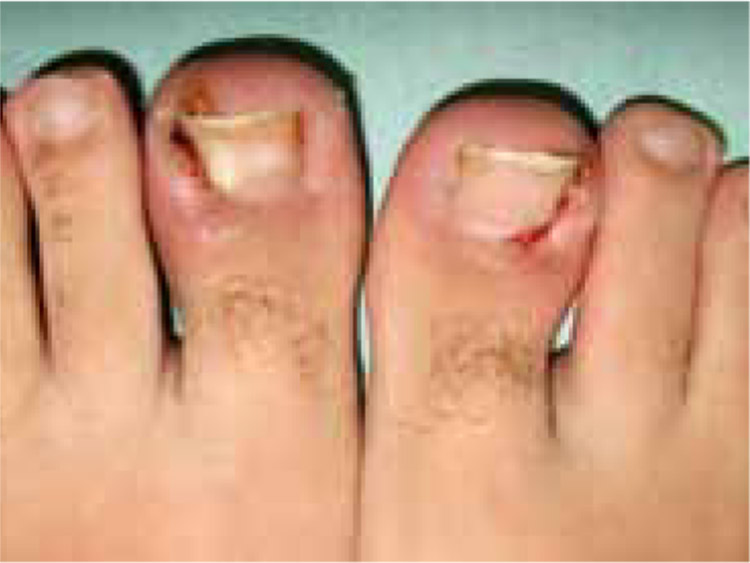
Onychocryptosis is a common, recurrent, painful condition that results in prolonged disability in affected patients. Several surgical techniques are available to approach this problem and to date none are standardized.
Objetive: To evaluate a surgical technique for the treatment of onychocryptosis.
Methodology: This is a two phase descriptive study: one retrospective phase with patients intervened from January 1998 to May 2009, and a prospective phase from June 2009 to December 2010, with a six follow up. Patients included were evaluated in the Clínica Universitaria Bolivariana and Clínica SOMA.
Results: Fifty seven patients were evaluated: 45 in the retrospective phase and 12 in the prospective phase. An analysis by surgical unit was performed, obtaining 92 procedures in the retrospective phase and 31 in the prospective phase. Onychocryptosis relapse in the retrospective group was 3.3 % (3/92). The most common complications were angular spicula (3.3 %) and procedure site dysesthesia (3.3 %). In the prospective phase group no relapse was observed (0/31). Two surgical site infections were observed (6.5 %) and onycholysis in the initial postsurgical phase in 19.4 % (6/31). All patients, with exception of those presenting relapse in the retrospective phase, referred notorious improvement of symptoms and satisfaction with the esthetic and functional results.
Conclusion: The proposed surgical technique, used for more than 10 years, is effective, has a low relapse rate and few complications.
Author Biographies
Ana Milena Montes
Médica dermatóloga, Facultad de Medicina, Escuela de Ciencias de la Salud, Universidad Pontificia Bolivariana, Medellín, Colombia
Luz Marina Gómez
Médica dermatóloga; profesora titular, jefe del Servicio de Dermatología, Facultad de Medicina, Escuela de Ciencias de la Salud, Universidad Pontificia Bolivariana, Medellín, Colombia
Ángela Londoño
Médica dermatóloga y epidemióloga; docente, Facultad de Medicina, Escuela de Ciencias de la Salud, Universidad Pontificia Bolivariana, Medellín, Colombia
Yuliana Arias
Estudiantes de Medicina, Facultad de Medicina, Escuela de Ciencias de la Salud, Universidad Pontificia Bolivariana, Medellín, Colombia
Edna Martínez
Estudiantes de Medicina, Facultad de Medicina, Escuela de Ciencias de la Salud, Universidad Pontificia Bolivariana, Medellín, Colombia
References
2. Heidelbaugh JJ, Lee H. Management of the ingrown toenail. Am Fam Physician. 2009;79:303-8.
3. Kline A. Onychocryptosis: A simple classification system. Foot Ank J. 2008;1:6.
4. Yang G, Yanchar N, Lo A, Jones A. Treatment of ingrown toenails in the pediatric population. J Pediatr Surg. 2008;43:931-5.
5. Rounding C, Bloomfield S. Surgical treatments for ingrowing toenails. Cochrane Database Syst Rev. 2005;18:CD001541.
6. Krull EA. Toenail surgery. En: Krull EA, Zook EG, Baran R, Haneke E. Nail surgery: a text and atlas. Philadelphia: Lippincott Williams & Wilkins; 2001. p. 135-61.
7. Noel B. Surgical treatment of toenail without matricectomy. Dermatol Surg. 2008;34:79-83.
8. Sardi JR. Onicocriptosis: uña encarnada. Dermatol Venez. 1996;2:57-60.
9. Alam M, Scher RK. Indinavir-related recurrent paronychia and ingrown toenails. Cutis. 1999;64:277-9.
10. Gómez LM, Villegas M, Restrepo R. Onicocriptosis en pacientes con infección por VIH. Infectio. 2003;7:226-9.
11. García-Silva J, Almagro M, Juega J, Peña C, López-Calvo S, del Pozo J, et al. Protease inhibitor-related paronychia, ingrown toenails, desquamative cheilitis and cutaneous xerosis. AIDS. 2000;14:1289-91.
12. Kruijff S, van Det RJ, van Der Meer GT, van Den Berg IC, van Der Palen J, Geelkerken RH. Partial matrix excision or orthonyxia for ingrowing toenails. J Am Coll Surg. 2008;206:148-53.
13. Hassel JC, Hassel AJ, Loser C. Phenol chemical matricectomy is less painful, with shorter recovery times but higher recurrence rates, than surgical matricectomy: A patient’s view. Dermatol Surg. 2010;36:1294-9.
14. Fernández G, Enríquez J. Onicocriptosis: estudio comparativo del periodo posoperatorio de una matricectomía parcial lateral con el de una matricectomía parcial lateral con fenolización. Dermatol Rev Mex. 2006;50:87-93.
15. Peyvandi H, Robati RM, Yegane RA, Hajinasrollah E, Toossi P, Peyvandi AA, et al. Comparison of two surgical methods (Winograd and Sleeve method) in the treatment of ingrown toenail. Dermatol Surg. 2011;37:331-5.
16. Córdoba-Fernández A, Ruiz-Garrido G, Canca-Cabrera A. Algorithm for the management of antibiotic prophylaxis in onychocryptosis surgery. Foot. 2010;20:140-5.
How to Cite
Downloads
Downloads
Published
How to Cite
Issue
Section
| Article metrics | |
|---|---|
| Abstract views | |
| Galley vies | |
| PDF Views | |
| HTML views | |
| Other views | |