Impact of Adalimumab on lymphocyte T infiltration in patiensts with psoriasis.
DOI:
https://doi.org/10.29176/2590843X.299Keywords:
Adalimumab, CD4 lymphocytes, CD8 lymphocytesAbstract
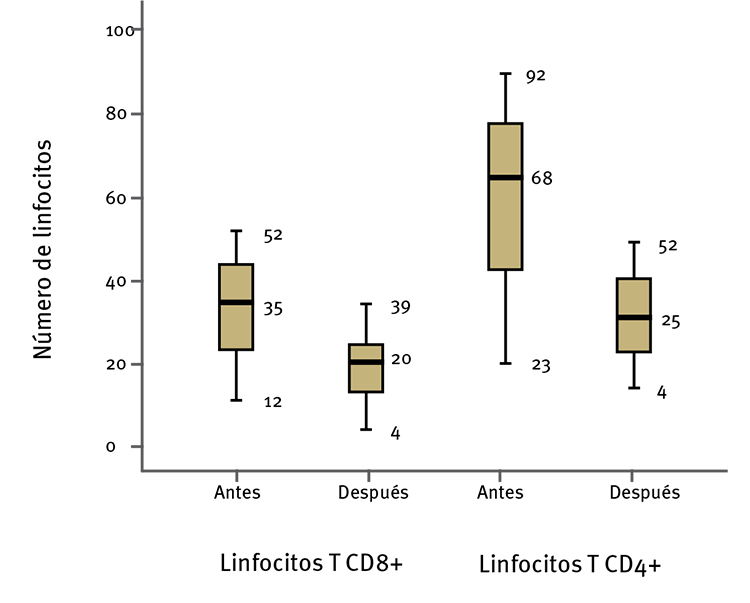
Objetive: To evaluate the impact of adalimumab in reducing T lymphocyte infiltration in the skin of patients with psoriasis. Material and methods: A pre-test – post-test study was conducted from March until December 2011. Patients with psoriasis older than 18 years of age with a PASI >10 were included. Patients who had received treatment with infliximab, etanercept, cyclosporine, metotrexate and those not stopping any topical treatment for at least two months before enrolled were excluded. A skin biopsy was taken before and at 28 weeks of treatment with adalimumab. Biopsies were examined by H and E and inmunohistochemistry tecniques. T Student and chi square tests were used for the statistical analysis. Results: Twenty two patients with psoriasis were included. The mean age was 51.6 years (range, 32-70) (p=0.70). The time of progression of the disease was 7.5 years (range, 2-30) (p=0.905). The CD4+ T lymphocyte counts was 58.8% (p=0.000) lower after treatment. The CD8+ T lymphocyte counts was 41.5% (p=0.000) lower after treatment. Conclusions: Adalimumab reduces significantly the T lymphocytes infiltration in the epidermis of patients with psoriasis.
Author Biographies
Ismael Cheng-Flores
Servicio de Dermatología, Hospital de especialidades Nº 25, Centro Médico Nacional del Noreste, Instituto Mexicano del Seguro Social, Monterrey, México.
Mario Amaya-Guerra
Servicio de Dermatología, Hospital de especialidades Nº 25, Centro Médico Nacional del Noreste, Instituto Mexicano del Seguro Social, Monterrey, México.
Diana González-Cabello
Servicio de Anatomía Patológica, Unidad médica de alta especialidad Nº 34, Centro Médico Nacional del Noreste, Instituto Mexicano del Seguro Social, Monterrey, México.
References
2. Harvell JD, Nowfar-Rad M, Sundram U. An immunohistochemical study of CD, CD8, TIA-1 and CD56 subsets in inflammatory skin disease. J Cutan Pathol. 2003;30:108-13.
3. Dikicioglu E, Ergin F, Unal E. Nature of cell kinetics in psoriatic epidermis. J Cut Pathol. 2007;34:257-63.
4. Prinzt JC. Role of T cell in psoriasis. J Eur Acad Dermatol Venereol. 2003;17:257-70.
5. Smith CH, Baker JNWN. Cell trafficking and role of adhesion molecules in psoriasis. In: van de Kerkkhof PCM, Bos JD, editors. Pathogenetic aspects of psoriasis. New York: Elsevier; 1995. p. 151-60.
6. Romero WA, De la Cruz C. Recomendaciones para uso de agentes biológicos en psoriasis. Revista Chilena de Dermatología. 2010;26:55-71.
7. Menter A, Tyrin SK, Kimball AB, Leonardi CL, Langley RG, Strober BE. Adalimumab therapy for moderate to severe psoriasis: A randomized, controlled phase III trial. J Am Acad Dermatol. 2008;58:598-606.
8. Saurat JH, Stingl G, Dubertret L, Papp K, Langley RG, OtorneJPl, CHAMPIONS Study Investigators. Efficacy and safety results from the randomized controlled comparative study of adalimumab vs.metotrexate vs. placebo in patients whith psoriasis (CHAMPION). Br J Dermatol. 2008;158:558-66.
9. Morganroth GS, Chan LS, Weintein GD, Voorhes JJ, Cooper KD. Proliferating cells in psoriatic dermis are comprised primarily of T cells, endothelial cells, and factor XIIIa+ perivascular dendritic cells. J Invest Dermatol. 1991;96:333-40.
10. Gómez-Mateo C, Ávalos-Peralta SP, Ríos-Martín JJ, Carrizosa-Esquivel AM, González-Cámpora R, Camacho-Martínez F. Evaluación histológica secuencial de marcadores de proliferación y apoptosis durante el tratamiento de la psoriasis con anti-factor de necrosis tumoral alfa (infliximab). Actas Dermosifiliogr. 2009;100:420-4.
11. Bovenschen HJ, Gerritsen WJ, van Rens DW, Seyger MM. Explorative inmunohistochemical study to evaluate the addition of topical corticosteroids in the early phase of alefacept treatment for psoriasis. Arch Dermatol Res. 2007;298:457-63.
12. Bauroudijian B, Viguier M, Battistela M, Beneton N, Pages C. Psoriasis associated with idiopathic CD4+ T-cell lymphopenia: A regulatory T-cell defect? Br J Dermatol. 2014;171:186-9.
13. Park GT, Han J, Park SG, Kim TY. DNA methylation analysys of CD4+ T cell in patients with psoriasis. Arc Dermatol Res. 2014;306:259-68.
14. Zhang P, Zhao M, Liangh G, Yin G, Huang D. Whole-genome DNA methylation in skin lesions from patients with psoriasis vulgar. J Autoinmmun.2013;41:17-24.
How to Cite
Downloads
Downloads
Published
How to Cite
Issue
Section
| Article metrics | |
|---|---|
| Abstract views | |
| Galley vies | |
| PDF Views | |
| HTML views | |
| Other views | |