Disseminated infection by Fusarium spp. in a patient with aplastic anemia.
Keywords:
aplastic anemia, Fusarium spp., febrile neutropeniaAbstract
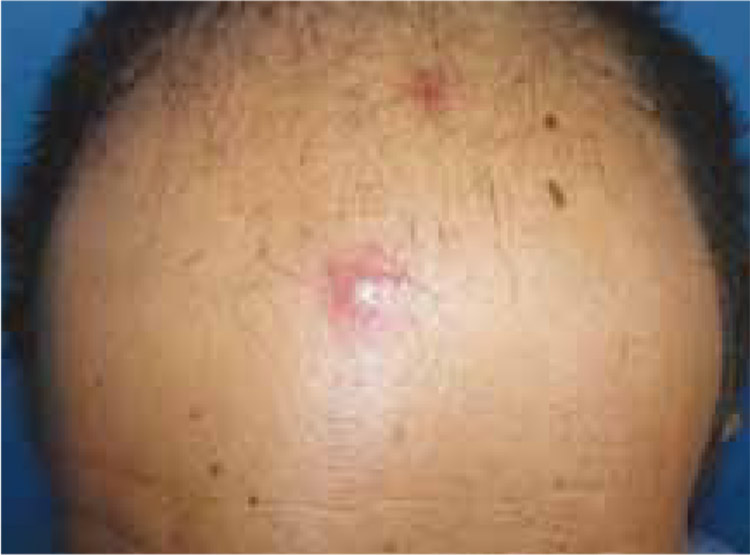
Disseminated fusarium is an opportunistic infection by Fusarium species, that occurs primarily in patients with hematologic malignancies due to prolonged neutropenia, with a mortality of up to 76% in case series described. Its clinical manifestations are varied and include associated devices, locally invasive, which describes the cutaneous manifestations and disseminated fusarium. Its diagnosis highlights the importance of histopathologic and culture findings. Treatment is generally not effective unless it restores cellular immunity. A case of a man of 46 years with de novo diagnosis of aplastic anemia is presented, with polymorphous skin lesions and Fusarium spp. was cultured from it. We review the historical, epidemiological, clinical, diagnostic and treatment aspects of the disease
Author Biographies
Carolina Giraldo
Médica, residente de tercer año de Dermatología, Universidad de Antioquia.
Margarita María Velásquez
Médica dermatóloga, Doctor en Ciencias Biomédicas énfasis en Inmunología, Universidad de Antioquia.
Grupo de Investigación Dermatológica, GRID, Sección de Dermatología, Facultad de Medicina, Universidad de Antioquia
Luis Alfonso Correa
Médico patólogo, docente de Dermatopatología, Universidad de Antioquia.
Grupo de Investigación Dermatológica, GRID, Sección de Dermatología, Facultad de Medicina, Universidad de Antioquia.
References
2. Franco L. Fusarium spp. En: Restrepo A, Robledo J, Leiderman W. E, Restrepo M, Botero D, Bedoya V, editores. Enfermedades infecciosas. Sexta edición. Medellín: Corporación para Investigaciones Biológicas; 2003. p. 696-9.
3. Nelson PE, Dignani MC, Anaissie EJ. Taxonomy, biology, and clinical aspects of Fusarium species. Clin Microbiol Rev. 1994;7:479-504.
4. Cho CT, Vats TS, Lowman JT, Brandsberg JW, Tosh FE. Fusarium solani infection during treatment for acute leukemia. J Pediatr. 1973;83:1028-31.
5. Martino P, Gastaldi R, Raccah R, Girmenia C. Clinical patterns of Fusarium infections in immunocompromised patients. J Infect. 1994;28(Suppl.1):7-15.
6. Naggie S, Perfect JR. Molds: Hyalohyphomycosis, phaeohyphomycosis, and zygomycosis. Clin Chest Med. 2009;30:337- 53.
7. De La Rosa GR, Champlin RE, Kontoyiannis DP. Risk factors for the development of invasive fungal infections in allogeneic blood and marrow transplant recipients. Transpl Infect Dis. 2002;4:3-9.
8. Girmenia C, Pagano L, Corvatta L, Mele L, del Favero A, Martino P. The epidemiology of fusariosis in patients with haematological diseases. Gimema Infection Programme. Br J Haematol. 2000;111:272-6.
9. Flowers ME, Kansu E, Sullivan KM. Pathophysiology and treatment of graft-versus-host disease. Hematol Oncol Clin North Am. 1999;13:1091-112.
10. Jantunen E, Ruutu P, Niskanen L, Volin L, Parkkali T, Koukila-Kähkölä P, et al. Incidence and risk factors for invasive fungal infections in allogeneic BMT recipients. Bone Marrow Transplant. 1997;19:801-8.
11. Goodman JL, Winston DJ, Greenfield RA, Chandrasekar PH, Fox B, Kaizer H, et al. A controlled trial of fluconazole to prevent fungal infections in patients undergoing bone marrow transplantation. N Engl J Med. 1992;326:845-51.
12. Hospenthal DR. Uncommon fungi. En: Mandell GL, Bennett JE, Dolin R, editors. Principles and Practice of Infectious Diseases. Sixth edition. Philadelphia: Churchill Livingstone; 2005. p. 3068-79.
13. Romani L. Immunity to fungal infections. Nat Rev Immunol. 2004;4:1-23.
14. Nucci M, Anaissie E. Fusarium infections in immunocompromised patients. Clin Microbiol Rev. 2007;20:695-704.
15. Dóczi I, Gyetvai T, Kredics L, Nagy E. Involvement of Fusarium spp. in fungal keratitis. Clin Microbiol Infect. 2004;10:773-6.
16. Tiribelli M, Zaja F, Filì C, Michelutti T, Prosdocimo S, Candoni A et al. Endogenous endophthalmitis following disseminated fungemia due to Fusarium solani in a patient with acute myeloid leukemia. Eur J Haematol. 2002;68:314-7.
17. Nucci M, Anaissie E. Emerging fungi. Infect Dis Clin North Am. 2006;20:563-79.
18. McNeely DJ, Vas SI, Dombros N, Oreopoulos DG. Fusarium peritonitis: an uncommon complication of continuous ambulatory peritoneal dialysis. Perit Dial Bull. 1981;1:94-6.
19. Flynn JT, Meislich D, Kaiser BA, Polinsky MS, Baluarte HJ. Fusarium peritonitis in a child on peritoneal dialysis: Case report and review of the literature. Perit Dial Int. 1996;16:52-7.
20. Velasco E, Martins CA, Nucci M. Successful treatment of catheter-related fusarial infection in immunocompromised children. Eur J Clin Microbiol Infect Dis. 1995;14:697-9.
21. Raad I, Hachem R. Treatment of central venous catheterrelated fungemia due to Fusarium oxysporum. Clin Infect Dis. 1995;20:709-11.
22. Wickern GM. Fusarium allergic fungal sinusitis. J Allergy Clin Immunol. 1993;92:624-5.
23. Musa MO, Al Eisa A, Halim M, Sahovic E, Gyger M, Chaudhri N, et al. The spectrum of Fusarium infection in immunocompromised patients with haematological malignancies and in non-immunocompromised patients: A single institution experience over 10 years. Br J Haematol. 2000;108:544-8.
24. Pino Rivero V, Trinidad Ruiz G, Keituqwa Yáñez T, Marcos García M, Pardo Romero G, González Palomino A, et al. Maxillary sinusitis by Fusarium sp. Report of a case and literature review. An Otorrinolaringol Ibero Am. 2004;31:341-7.
25. Saubolle MA. Fungal pneumonias. Semin Respir Infect. 2000;15:162-77.
26. Zuluaga A, De Bedout C, Tabares A, Cano LE, Restrepo A, Arango M, et al. Comportamiento de los agentes etiológicos de las onicomicosis en un laboratorio de micología de referencia (Medellín 1994-2003). Med Cutan Iber Lat Am. 2005;33:251-6.
27. Gupta AK, Baran R, Summerbell RC. Fusarium infections of the skin. Curr Opin Infect Dis. 2000;13:121-8.
28. Calado NB, Sousa F Jr, Gomes NO, Cardoso FR, Zaror LC, Milan EP. Fusarium nail and skin infection: a report of eight cases from Natal, Brazil. Mycopathologia. 2006;161:27-31.
29. Castro López N, Casas C, Sopo L, Rojas A, Del Portillo P, Cepero de García MC, Restrepo S. Fusarium species detected in onychomycosis in Colombia. Mycoses. 2008;52:350-6.
30. Mallo-García S, Coto-Segura P, Santos-Juanes-Jiménez J. Proximal white subungual onychomycosis due to Fusarium species. Actas Dermosifiliogr. 2008;99:742-3.
31. Arrese JE, Piérard-Franchimont C, Piérard GE. Fatal hyalohyphomycosis following Fusarium onychomycosis in an immunocompromised patient. Am J Dermatopathol. 1996;18:196-8.
32. Bodey GP, Boktour M, Mays S, Duvic M, Kontoyiannis D, Hachem R, Raad I. Skin lesions associated with Fusarium infection. J Am Acad Dermatol. 2002;47:659-66.
33. Zhang CZ, Fung MA, Eisen DB. Disseminated fusariosis presenting as panniculitis-like lesions on the legs of a neutropenic girl with acute lymphoblastic leukemia. Dermatol Online J. 2009;15:5.
34. Hamaki T, Kami M, Kishi A, Kusumi E, Kishi Y, Iwata H et al. Vesicles as initial skin manifestation of disseminated fusariosis after non-myeloablative stem cell transplantation. Leuk Lymphoma. 2004;45:631-3.
35. Segal BH, Walsh TJ, Liu JM, Wilson JD, Kwon-Chung KJ. Invasive infection with Fusarium chlamydosporum in a patient with aplastic anemia. J Clin Microbiol. 1998;36:1772-6.
36. Valdez JM, Scheinberg P, Young NS, Walsh TJ. Infections in patients with aplastic anemia. Semin Hematol. 2009;46:269-76.
37. Liu K, Howell DN, Perfect JR, Schell WA. Morphologic criteria for the preliminary identification of Fusarium, Paecilomyces, and Acremonium species by histopathology. Am J Clin Pathol. 1998;109:45-54.
38. Kobayashi K, Hayama M, Hotchi M. The application of immunoperoxidase staining for the detection of causative fungi in tissue specimens of mycosis. Mycopathologia. 1988;102:107-13.
39. Hue FX, Huerre M, Rouffault MA, de Bievre C. Specific detection of Fusarium species in blood and tissues by a PCR technique. J Clin Microbiol. 1999;37:2434-8.
40. Moskowitz LB, Ganjei P, Ziegels-Weissman J, Cleary TJ, Penneys NS, Nadji M. Immunohistologic identification of fungi in systemic and cutaneous mycoses I. Arch Pathol Lab Med. 1986;110:433-6.
41. Ahmad S, Khan ZU, Theyyathel AM. Development of a nested PCR assay for the detection of Fusarium solani DNA and its evaluation in the diagnosis of invasive fusariosis using an experimental mouse model. Mycoses. 2010;53:40-7.
42. Healy M, Reece K, Walton D, Huong J, Frye S, Raad II, et al. Use of the Diversi Lab System for species and strain differentiation of Fusarium species isolates. J Clin Microbiol. 2005;43:5278-80.
43. Bunya VY, Hammersmith KM, Rapuano CJ, Ayres BD, Cohen EJ. Topical and oral voriconazole in the treatment of fungal keratitis. Am J Ophthalmol. 2007; 143:151-3.
44. Ho DY, Lee JD, Rosso F, Montoya JG. Treating disseminated fusariosis: amphotericin B, voriconazole or both? Mycoses. 2007;50:227-31.
45. Dignani MC, Anaissie E. Human fusariosis. Clin Microbiol Infect. 2004; 10 (Suppl.1):67-75.
46. Guimerá-Martín-Neda F, García-Bustínduy M, Noda-Cabrera A, Sánchez-González R, Montelongo RG. Cutaneous infection by Fusarium: successful treatment with oral voriconazole. Br J Dermatol. 2004;150:777-8.
47. Consigny S, Dhedin N, Datry A, Choquet S, Leblond V, Chosidow O. Successful voriconazole treatment of disseminated fusarium infection in an immunocompromised patient. Clin Infect Dis. 2003;37:311-3.
48. Stanzani M, Vianelli N, Bandini G, Paolini S, Arpinati M, Bonifazi F, et al. Successful treatment of disseminated Fusariosis after allogeneic hematopoietic stem cell transplantation with the combination of voriconazole and liposomal amphotericin B. J Infect. 2006;53:243-6.
49. Muñoz P, Guinea J, Bouza E. Treatment options in emerging mold infections. Curr Infect Dis Rep. 2008;10:473-9.
50. Girmenia C, Iori AP, Boecklin F, Torosantucci A, Chiani P, De Fabritiis P, et al. Fusarium infections in patients with severe aplastic anemia: review and implications for management. Haematologica. 1999;84:114-8.
51. Raad II, Hachem RY, Herbrecht R, Graybill JR, Hare R, Corcoran G, et al. Posaconazole as salvage treatment for invasive fusariosis in patients with underlying hematologic malignancy and other conditions. Clin Infect Dis. 2006;42:1398-403.
52. Hennequin C, Benkerrou M, Gaillard JL, Blanche S, Fraitag S. Role of granulocyte colony-stimulating factor in the management of infection with Fusarium oxysporum in a neutropenic child. Clin Infect Dis. 1994;18:490-1.
53. Nucci M, Anaissie EJ, Queiroz-Telles F, Martins CA, Trabasso P, Solza C, et al. Outcome predictors of 84 patients with hematologic malignancies and Fusarium infection. Cancer. 2003; 98:315-9.
How to Cite
Downloads
Downloads
Published
How to Cite
Issue
Section
| Article metrics | |
|---|---|
| Abstract views | |
| Galley vies | |
| PDF Views | |
| HTML views | |
| Other views | |