Juvenile scalp xanthogranuloma
a diagnostic challenge
DOI:
https://doi.org/10.29176/30284163.1949Keywords:
Histiocytosis, Juvenile xanthogranuloma, Scalp noduleAbstract
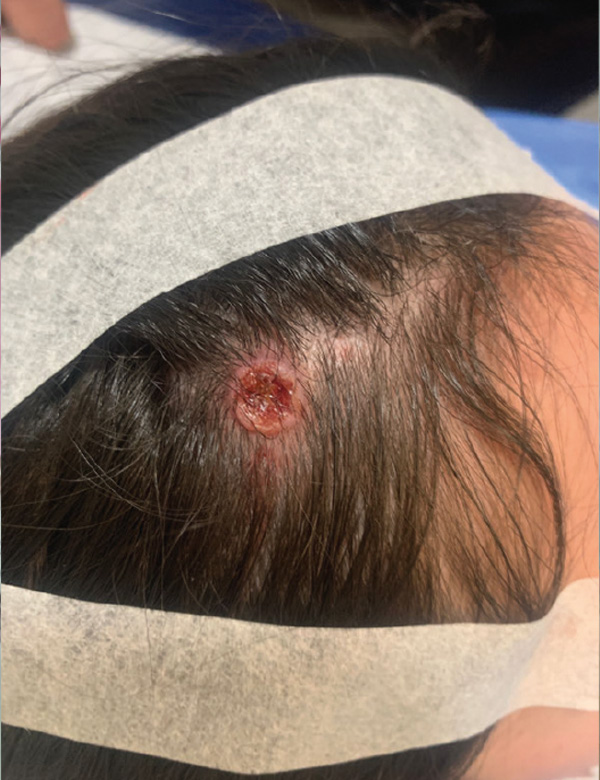
Juvenile xanthogranuloma (JXG) is a rare benign proliferative disorder, which belongs to the non-Langerhans cell histiocytosis group. It is the most common form of histiocytosis in childhood, presenting mainly as nodules on the head and neck. It usually appears before one year of age, and although it is rare in adults, it manifests as yellow-orange nodules, mainly on the face, neck, and upper torso. The case of a 7-year-old patient with JXG on the scalp is presented, with a review of the epidemiological, pathogenic and clinical characteristics of JXG. Understanding the various manifestations, varied locations, and possible systemic involvement of JXG remains crucial for accurate diagnosis and appropriate management, primarily conservative observation, educating patients about the benign course of the disease, and surgical removal if necessary.
Author Biographies
Carolina Droguett Saavedra, Universidad De Santiago de Chile
Residente de Dermatología, Hospital El Pino, Universidad de Santiago de Chile
Manuela Betanzo, Universidad de Santiago de Chile
Residente de Dermatología, Hospital El Pino, Universidad de Santiago de Chile
Andrés Wunderwald, Universidad de Santiago de Chile
Residente de Dermatología, Hospital El Pino, Universidad de Santiago de Chile
Stefania Toso, Hospital El Pino, Santiago de Chile
Dermatóloga, Hospital El Pino, Santiago de Chile
Francisco Chávez, Hospital El Pino, Santiago de Chile
Dermatólogo, Hospital El Pino, Santiago de Chile
How to Cite
Downloads
Downloads
Published
How to Cite
Issue
Section
License
Copyright (c) 2024 Carolina Droguett Saavedra, Manuela Betanzo, Andrés Wunderwald, Stefania Toso, Francisco Chávez

This work is licensed under a Creative Commons Attribution-NonCommercial-ShareAlike 4.0 International License.