School child with severe dermatitis, alopecia universalis and recurrent infections: when zinc is the key: case report
DOI:
https://doi.org/10.29176/30284163.2079Keywords:
acrodermatitis enteropathica, acrodermatitis enteropathica zinc deficiency type, alopecia universalis, SLC39A4 protein humanAbstract
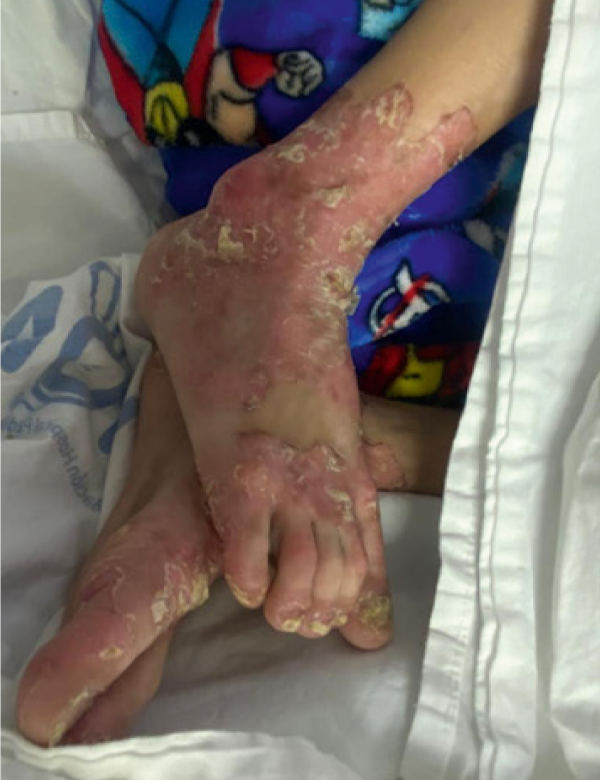
Acrodermatitis enteropathica is a rare disease caused by variants in the SLC39A4 gene, which encodes a member of the zinc/iron-regulated transporter-like protein (ZIP) family. This gene is required for zinc uptake in the intestine. We present the case of a 6-year-old male child with periorificial lesions, alopecia universalis, and nail abnormalities. He was found to have a low height and body mass index (BMI) for his age. The laboratory workup revealed depleted serum zinc levels. Sanger sequencing identified a homozygous likely pathogenic variant in the SLC39A4 gene. After zinc sulfate supplementation, there was an improvement in the skin lesions, complete hair recovery, and resolution of the nail abnormalities.
We review the relevance of zinc in protein synthesis and its crucial role as a component in multiple physiological processes such as immune function, neurotransmission, cognitive functions, and intestinal barrier permeability. Since we do not synthesize zinc, absorption in the intestine from the diet is fundamental to maintain adequate zinc levels. A genetic defect in SLC39A4 causes severe zinc deficiency, which can be overcome by oral zinc supplementation, resulting in improved clinical characteristics. A high suspicion in patients with periorificial distribution of erythematous plaques, as well as alopecia and nail abnormalities, is critical for early clinical diagnosis. Zinc levels are readily available and should be measured.
Author Biographies
Natalia Vélez-Tirado, Fundación Hospital Pediátrico la Misericordia, Bogotá, Colombia
Pediatric immunology, HOMI, Fundación Hospital Pediátrico la Misericordia, Bogotá, Colombia
Lina Castano-Jaramillo, Fundación Hospital Pediátrico la Misericordia, Bogotá, Colombia
Pediatric immunology, HOMI, Fundación Hospital Pediátrico la Misericordia, Bogotá, Colombia
Lina Baños, Fundación Hospital Pediátrico la Misericordia, Bogotá, Colombia
Pediatric gastroenterology, HOMI, Fundación Hospital Pediátrico la Misericordia, Bogotá, Colombia.
Stephania Peña, Fundación Hospital Pediátrico la Misericordia, Bogotá, Colombia
Pediatric gastroenterology, HOMI, Fundación Hospital Pediátrico la Misericordia, Bogotá, Colombia.
Wilber Martínez, Universidad Militar Nueva Granada, Bogotá, Colombia
Dermatology resident, Universidad Militar Nueva Granada, Bogotá, Colombia.
Maribel Trujillo, Fundación Hospital Pediátrico la Misericordia, Bogotá, Colombia
Pediatric dermatology, HOMI, Fundación Hospital Pediátrico la Misericordia, Bogotá, Colombia.
References
Hua W, Zou J, Zhuang Y, et al. Case report: Acrodermatitis enteropathica result from a novel SLC39A4 gene mutation. Frontiers in Pediatrics. 2022;10. https://www.frontiersin.org/articles/10.3389/fped.2022.972030. Accessed November 14, 2023.
Zhong W, Yang C, Zhu L, et al. Analysis of the relationship between the mutation site of the SLC39A4 gene and acrodermatitis enteropathica by reporting a rare Chinese twin: a case report and review of the literature. BMC Pediatrics. 2020;20(1):34.
Costa MI, Sarmento-Ribeiro AB, Gonçalves AC. Zinc: From Biological Functions to Therapeutic Potential. International Journal of Molecular Sciences. 2023;24(5):4822.
Abbas HS, Abd-Elhakeem MM, Abd El Galil RM, et al. Natural Immunomodulators Treat the Cytokine Storm in SARS-CoV-2. Adv Pharm Bull. 2023;13(1):79–87.
Hawrysz Z, Woźniacka A. Zinc: an undervalued microelement in research and treatment. Adv Dermatol Allergol. 2023;40(2):208–214.
Al-Khafaji Z, Brito S, Bin B-H. Zinc and Zinc Transporters in Dermatology. International Journal of Molecular Sciences. 2022;23(24):16165.
Higuchi S, Yorifuji T, Nishida M, et al. Acrodermatitis enteropathica: a hereditary form of zinc deficiency. QJM: An International Journal of Medicine. 2021;114(4):270–271.
Glutsch V, Hamm H, Goebeler M. Zinc and skin: an update. JDDG: Journal der Deutschen Dermatologischen Gesellschaft. 2019;17(6):589–596.
Borroni G, Brazzelli V, Vignati G, et al. Bullous lesions in acrodermatitis enteropathica. Histopathologic findings regarding two patients. Am J Dermatopathol. 1992;14(4):304–309.
Maywald M, Rink L. Zinc in Human Health and Infectious Diseases. Biomolecules. 2022;12(12):1748.
How to Cite
Downloads
Downloads
Published
How to Cite
Issue
Section
License
Copyright (c) 2025 NATALIA VELEZ TIRADO

This work is licensed under a Creative Commons Attribution-NonCommercial-ShareAlike 4.0 International License.