Pyosis mansoni: clinical and dermoscopic correlation of a case
DOI:
https://doi.org/10.29176/2590843X.2041Keywords:
Axilla, Impetigo contagiosa, Infectious, Pemphigus, Skin diseasesAbstract
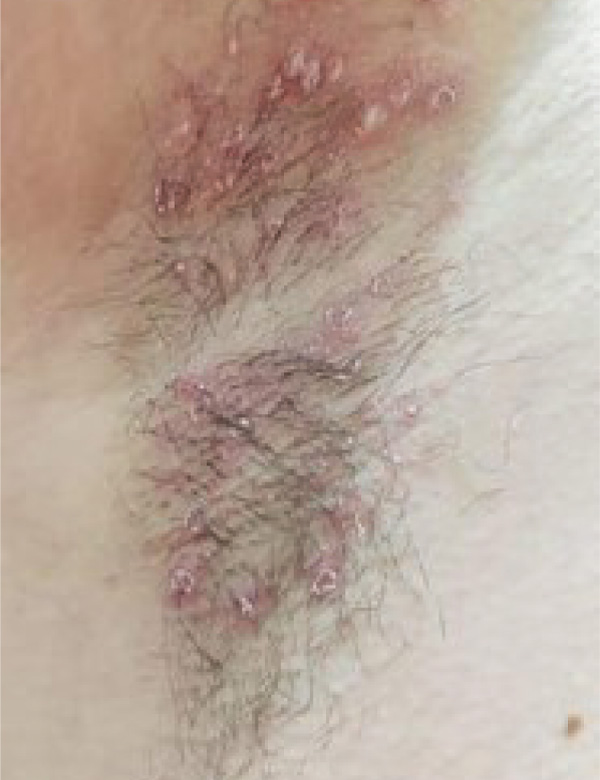
Impetigo is a bacterian infection that affects the surface of the skin. It can be adquired at any age, however it's most frequently seen in children under 5 years old. It is divided in two categories: contagious and bullous. This case report highlights a particular strain of contagious impetigo called Pyosis mansoni, which is most frequently found in the armpit area. Its diagnostic is clinic. It can resolve itself, however, there had been reported cases where topical and/or treatments are required.
Author Biographies
Freddy Fernando Fonseca Lopez, Universidad Militar Nueva Granada, Bogotá, Colombia
Médico general, Universidad Militar Nueva Granada.
Aura Catherine Rodríguez Estupiñan, Hospital Universitario Centro Dermatológico Federico Lleras Acosta, E.S.E., Bogotá, D.C., Colombia
Dermatóloga, Hospital Universitario Centro Dermatológico Federico Lleras Acosta
Diana Alejandra Peña Chaparro, Universidad Militar Nueva Granada, Bogotá, Colombia
Médica general, Universidad Militar Nueva Granada
Miller Andres Martinez Jiménez, Universidad Militar Nueva Granada, Bogotá, Colombia
Médico general, Universidad Militar Nueva Granada
References
Koning, S., van der Sande, R., Verhagen, A. P., van Suijlekom-Smit, L. W., Morris, A. D.,et al. (2012). Interventions for impetigo. In Cochrane Database of Systematic Reviews (Vol. 2012, Issue 1, pp. 1–3). John Wiley and Sons Ltd. https://doi.org/10.1002/14651858.CD003261.pub3.
Flores, R., Villarroel, J. L., & Valenzuela, F. (2021). Managing adult skin infections. Revista Medica Clinica Las Condes, 32(4), 429–441. https://doi.org/10.1016/j.rmclc.2021.06.004.
Bowen, A. C., Mahé, A., Hay, R. J., Andrews, R. M., Steer, A. C., Tong, S. Y. C., et al. (2015). The global epidemiology of impetigo: A systematic review of the population prevalence of impetigo and pyoderma. PLoS ONE, 10(8). https://doi.org/10.1371/journal.pone.0136789.
Yeoh, D. K., Bowen, A. C., & Carapetis, J. R. (2016). Impetigo and scabies – Disease burden and modern treatment strategies. Journal of Infection, 72, S61–S67. https://doi.org/10.1016/j.jinf.2016.04.024.
F.A. Moraga, L., & A Martínez, R. (2012). Enfermedades bacterianas de la piel. Pediatr Integral , XVI(3), 235–243.
Manzur, Díaz, A., & Cortés. (2002). Dermatología. ECIMED.
Pereira, L. B. (2014). Impetigo - Review. In Anais Brasileiros de Dermatologia (Vol. 89, Issue 2, pp. 293–299). Sociedade Brasileira de Dermatologia. https://doi.org/10.1590/abd1806-4841.20142283.
Vera Cárdenas, P. J., Macera Tenecela, C. E., Siguencia Sanmartín, J. A., & Ocaña Urquizo, G. G. (2023). Actualización en el diagnóstico y tratamiento de Impétigo. RECIMUNDO, 7(4), 245–250. https://doi.org/10.26820/recimundo/7.(4).oct.2023.245-250.
Rob, E., & Charlene, A. (2017). Topical antibiotics for impetigo: a review of the clinical effectiveness and guidelines service line: rapid response service.
Sander, K., & Johannes C, van der W. (2004). Treatment for impétigo evidence favours topical treatment with mupirocin, fusidic acid. BMJ, 329, 695–696.
Brown, J., Shriner, D. L., Schwartz, R. A., Janniger, C. K., & Robert, S. (2003). Impetigo: an update. International Journal of Dermatology, 42, 251–255.
Simons. (1946). Studies on Pyosis Mansoni or Impetigo bullosa tropica. Dermatologica, 189–194.
D’avanzo, C. S. (1945). IMPETIGO BULLOSA IN THE TROPICS. Dermatology and Syphilology, 28–29. http://archderm.jamanetwork.com/.
How to Cite
Downloads
Downloads
Published
How to Cite
Issue
Section
License
Copyright (c) 2025 Freddy Fernando Fonseca Lopez, Aura Catherine Rodríguez Estupiñan, Diana Alejandra Peña Chaparro, Miller Andres Martinez Jiménez

This work is licensed under a Creative Commons Attribution-NonCommercial-ShareAlike 4.0 International License.
| Article metrics | |
|---|---|
| Abstract views | |
| Galley vies | |
| PDF Views | |
| HTML views | |
| Other views | |